Blue Christmas has been recorded by hundreds of people since Elvis' Christmas Album came out in 1957. However, as you may suspect, the song was around before Elvis included it on that LP. Elvis didn't do too many original songs and it's difficult to tell who inspired him to record Blue Christmas. His version was quite unique and remains the benchmark of the song 56 years later. Blue Christmas was written by Billy Hayes and Jay W. Johnson and was first recorded by western singer Doye O'Dell in 1948.
The following year several recorded versions became hits. The first one, and biggest hit while remaining within the Country & Western circuit, was by Ernest Tubb.
Trombonist and orchestra leader Russ Morgan hit the charts with his version, on which he also did the vocal. Russ took the western type song and turned it into a very sappy and souless tune in the style very typical of the early 1950's. There were hundreds of great recordings made during the early 1950's, but they were all outside of the pop mainstream market. If necessity is the mother of invention, then rock 'n' roll was destined to happen by mid-decade. How much is that doggy in the window, indeed! (Of course, rock 'n' roll was around long before the mid-50's, but you know what I mean.)
Russ wasn't the only muzak master of Blue Christmas in 1949. Band leader Hugo Winterhalter recorded it twice. First during his brief stay on Columbia, from which he quickly jumped ship to Mercury where he recorded it again.
The following year, 1950, Hugo was involved in a third recording of Blue Christmas when his orchestra backed Billy Eckstine doing the song.
On the 5th of September 1957, Elvis recorded his version and most likely saved the song from historic obscurity.
This Christmas song has been recorded by hundreds of people (in this century alone). With a wide range and many sustained notes, it gives a singer a good opportunity to show off their chops.
Written by Hugh Martin for the 1944 film Meet Me In St. Louis, it made its public debut on 29 November 1944 sung by Judy Garland.
Needless to say, there were many people away from home during Christmas 1944 and the song made a larger impact than the film itself.
Frank Sinatra recorded the song, for the first time, on 26 June 1947 in Hollywood. The recordings from that session were scrapped for some reason and were all redone on July 3.
Ten years and 13 days later, 16 July 1957, Frank recorded it again in LA, and this recording was certainly one of the most popular recordings of the song you'd hear on the radio for quite a few years.
There have been so many recordings of this song made in the past 60 years, it really doesn't make much sense to even try to note them. Let's close out the post with two recordings that received a lot of airplay for a number of years after their release. The first one is sung by Karen Carpenter....from 1978.
Santa Claus Is Coming To Town was written by Haven Gillespie (lyrics) and J. Fred Coots (music) in 1932. (Gillespie also wrote the lyrics to That Lucky Old Sun which appeared on this blog in an earlier post.) The song was first recorded by banjo player Harry Reser & His Orchestra with vocals by Tom Stacks for Decca Records on October 24, 1934. However, before the record was released the song was performed by Eddie Cantor on his radio show sometime in November, which resulted in orders for about 100,000 copies of the sheet music the following day. Since then it has been recorded hundreds of times and is a very recognizable Christmas song. The song hasn't evolved much in the past 79 years. It's always been a very uptempo song. As musical styles have come and gone it has been adapted to fit those genres. From big bands to crooners to vocal harmony groups to pop groups to rockers. Some of the earliest recordings rocked. I wouldn't want to try and nominate any particular recording as the definitive one. I know in my younger days you heard the 1959 Perry Como recording a lot on the radio, then in the mid-60's the recording by The Crystals was popular for a time. Bruce Springsteen brought it back in the mid-70's. I've selected several recorded versions to illustrate its beginnings and sustainability through its first 50 years. Sorry, but I don't have time to track down any label shots or photo's tonight.
Harry Reser & His Orch. (Tom Stacks - vocal)
Recorded 24 October 1934
Tommy Dorsey & His Orch.
(Cliff Weston & Edythe Wright - vocals)
Recorded 26 September 1935
Woody Herman & His Orch.
from 1942
Bing Crosby & The Andrews Sisters
Recorded 29 September 1943
Perry Como with The Satisfiers from 1946
This has not been re-issued in any form in over 60 years.
Frank Sinatra
Recorded 28 December 1948
Patti Page
from 1951
Perry Como....again
from 1959
The Harmony Grits
from 1959
Ella Fitzgerald
from 1960
Skip Jackson & The Shantons
from 1960
The Crystals
from 1963
The Supremes
from 1965
The Jackson 5
from 1970
Bruce Springsteen & The E Street Band
at Hofstra University 12 December 1975
unreleased - promo copies given to radio stations
The Pointer Sisters from 1987
sounds like the above Springsteen recording minus the vocal
Pop Christmas song hits seem to have become a thing of the past. They went out with the 45 rpm record and live local radio not subjected to the tight constraints and alternative reality of political correctness. Once upon a time things were very different. Early popular Christmas music existed as carols and hymns, their growth and popularity spread by mouth-to-ear and by published scores (aka sheet music). With the arrival of commercial radio and distributed mass-produced recordings in the 1920's, the recording industry thrived and there was always a demand for new songs and writers were always in search of something to write about. Thousands of new "Christmas songs" were written and recorded, particularly in the 40's, 50's and 60's. Most of them were easily forgettable, but every now and then a classic seemed to be born and would return to the airwaves and record shops every Christmas season. Hopefully, between now and the end of the year, we can take a closer look at some of those songs.
Let's begin with a song that technically isn't even a Christmas song, but it always has been identified with the Christmas season.
Winter Wonderland was written in 1934 by Richard B. Smith (lyrics) and Felix Bernard (music). At the time, Smith was hospitalized in Scranton, Pennsylvania, suffering from tuberculosis, and would die from it within a year. We know that during the 1934 Christmas season at least three recorded versions made an impact with airplay and sales. The first recording was done in New York City by Richard Himber & His Ritz-Carlton Orchestra featuring Joey Nash on vocals.
On 11 November 1934 the song was recorded by Ted Weems & His Orchestra with Parker Gibbs on vocals. Personally, I feel this is the most significant of the early recordings as it was the first to perform the song in an up tempo festive manner, which is how it is best known today.
The most successful recording of Winter Wonderland in 1934 was the one done by Guy Lombardo and his orchestra, The Royal Canadians.
The song enjoyed renewed interest during the 1946 Christmas season, with hits by 3 different artists.
The first one was by, once again, Guy Lombardo....sort of. It was done by The Andrews Sisters with music provided by Guy Lombardo & His Royal Canadians.
Perry Como released his first recorded version of the song in 1946.
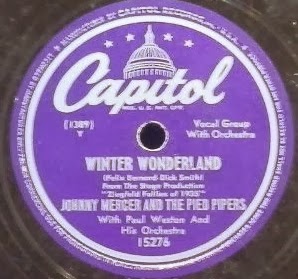
The biggest hit of Winter Wonderland in 1946 was recorded by famed songwriter Johnny Mercer. Johnny was on Capitol and their muscle-bound distribution network might have had something to do with that as, to me, the recording is painfully slow.
So, by the 1950's, Winter Wonderland was a well-established Christmas pop song that was regularly recorded. From the late 40's to the early 60's there were some nice versions that stood out from most of the others, but I'm going to skip over them and jump ahead to 1963 when, in Los Angeles, Phil Spector put together a classic LP of secular Christmas songs using several of the artists in his stable along with the famed Wrecking Crew group of LA studio musicians. The LP was released 50 years ago yesterday...the same Friday of the JFK assassination. Several songs from that LP have enjoyed many years of radio popularity. Darlene Love was selected to sing Winter Wonderland.
The days of vinyl pretty much came to an end during 1986 and with it the whole concept of Christmas novelty singles. In 1987 an assortment of American (Bruce Springsteen, Stevie Nicks, The Pointer Sisters, Whitney Houston, John Mellencamp, Run DMC, Madonna, Bob Seger, Bon Jovi), British (Eurythmics, The Pretenders, Sting, Alison Moyet), Irish (U2) and Canadian (Bryan Adams) musicians submitted Christmas song recordings for a charity CD called A Very Special Christmas. (The first of many.) Dave Stewart and Annie Lennox (Eurythmics) submitted their recording of Winter Wonderland and according to the one of the two major performance rights organizations, this version is still running strong 25+ years later and is the most popular version of the 21st century to date.
Sorry for not posting anything for 2 months. The 2 or 3 people that actually read this blog have probably disappeared. It was 50 years ago today, 11 February 1963 in case you can't do the math, that the Beatles entered the EMI Studios on Abbey Road in St. John's Wood to record their first LP. That's right, they recorded the LP in one day......sort of. That day, 50 years ago, was a pivotal day in the career of the group. A major turning point. For some 3 years or so they had been performing nearly every day in clubs, halls and ballrooms in the Liverpool area and in Hamburg. They were rockers who provided dance music. On the first day of 1962 they recorded 15 songs for Decca at their studio in London, but the label chose to pass on them and didn't offer them a contract. Six months later, on June 6, EMI offered them a studio audition under the supervision of producers Ron Richards and George Martin. They recorded 4 songs: Besame Mucho and 3 originals they wrote themselves: Love Me Do, PS I Love You and Ask Me Why. Feeling they had nothing to lose, EMI offered them a contract and had them return on Sept. 4 for a proper recording session. Shortly before that session they replaced drummer Pete Best with Ringo Starr. At the insistence of Martin, they recorded a song written by Mitch Murray called How Do You Do It? along with Love Me Do, which they had decided would be their first A-side. Unsatisfied with the results, they were asked to return for another session on Sept. 11. This time they got to record 3 of their own songs (Love Me Do, PS I Love You and an early version of Please Please Me) but the EMI staff insisted they use session drummer Andy White. On October 5, their first single, Love Me Do b/w PS I Love You, was released. The group returned to London on 26 November to record their next single: Please Please Me b/w Ask Me Why. They also did several takes of another song they wrote called Tip Of My Tongue. Unhappy with the arrangement, it was decided to return to it at a future session but they never did. They gave it to singer Tommy Quickly and then headed off to Hamburg again. The single was released 11 January 1963 and it was a big hit.....and that is what led to the decision to have them record a LP. Returning from Germany, they had spent a week performing in Scotland and then continued the regular routine of clubs and halls around the north before heading down to London for the session. In 1963 LP's were the secondary format to singles and would remain so until around 1968 when everything in the music business got turned upside down. The success of the Beatles was certainly one of the main reasons for the change. With 4 songs from their two singles available for the LP, they had to record the balance in one day as the next day they departed on a large package tour of ballrooms and halls with about 7 other acts that were headlined by Helen Shapiro who was about 16 at the time. This was a first for them. Instead of providing dance music for two hours for a club or dance hall, they only had to play 4 songs per show and did so as "performers" for an audience who purchased tickets to enter the venue to watch and listen. They now had a big hit record under their belts and their popularity was rapidly spreading. Very briefly, that is what brings us up to this date 50 years ago. The rest of this post is going to look at what went on in EMI Studio 2 that day except to mention one last thing in regards to the day being a turning point. After what they accomplished on this day 50 years ago, EMI lost any doubts they had in them and fully realized they were onto something special and believed in them. The 13 hours-or-so session began around 10 am. The Beatles had two songs they were anxious to get recorded and use for the LP and they went right to work on them. The first one was There's A Place. They did 10 takes.
Here's Take 1:
Take 2:
Take 3, a false start, into Take 4:
Take 5, a false start, into Take 6:
Take 7, a false start, into Take 8:
Take 9:
Take 10:
At this point they gave There's A Place a rest and moved on to the next song: I Saw Her Standing There. A great rocking song, they had been performing it live for at least several months. This is a performance from October 1962 at the Cavern Club in Liverpool.
and this one is supposedly New Year's Eve 1962 at the Star Club in Hamburg
At EMI they did 9 takes before taking a break. Take 1:
Take 2:
Takes 3, 4 and 5 were all edit pieces.
Takes 6 (breakdown), 7 and 8 were false starts - into Take 9:
At this point it was early afternoon and the morning session was over. The EMI staff headed to a pub for lunch while the Beatles remained in Studio 2 to rehearse for the afternoon session. When things resumed they did 5 takes of another song they had been performing live but was not a song they wrote: A Taste Of Honey. A Taste Of Honey was a 1958 British play written by then 18 year old Shelagh Delaney. In 1960 it opened on Broadway and the music for this song was added as a recurring theme. In 1961 it was made into a film in the UK and is now a kitchen sink classic. Lyrics were added to the music in 1962 and it was recorded by Lenny Welch and that was the inspiration for the Beatles recording.
The Beatles recorded 5 takes of the song. Take 1 was complete, but unsatisfactory. Takes 2 and 3 broke down, Take 4 was complete as was Take 5 but at that point they moved on to the next song, another Lennon-McCartney song but with the lead vocal by George Harrison, Do You Want To Know A Secret? Take 1 was a false start, Takes 2, 3 and 4 complete, Take 5 a false start, then Take 6 complete. They then did Take 7:
Following Take 7 they deemed Take 6 the best but wanted to do an 8th Take to get some added vocals and percussion dubbed onto Take 6. Take 8:
On Feb. 25 mixing Take 8 was done to create the mono master of the song. Stereo was just an afterthought back then. All the effort went into the mono mix and I'm not even sure if those original mono masters are still available these days, so I'll post them here. Finally, they had one song done. About a month later it was recorded by, and became a hit for, Billy J. Kramer & The Dakotas.
Do You Want To Know A Secret? - original mono master
Then they returned to A Taste Of Honey. Take 6:
At this point it was decided Take 5 was best but they wanted to record a Take 7 to dub added vocals onto Take 5, double-tracking them to get a fuller sound and creating a Take 8:
Editing and mixing was done 25 Feb. and here's the original mono master of A Taste Of Honey:
Then they returned to There's A Place. Take 11 which was an overdub of harmonica onto Take 10:
Take 12, a false start, into Take 13:
Take 13 was mixed and mastered on Feb. 25:
Next, they finished off I Saw Her Standing There. Take 10:
At that point they decided Take 1 was "best" and Take 11 (false start) and 12 are overdubbed hand claps onto Take 1. They later took the opening "1-2-3-4" from Take 9 and edited it onto Take 1.
Mixing and editing was done Feb. 25 and here's the original mono master:
Next up was another song they wrote, in fact they wrote it for Helen Shapiro but she turned them down. Too bad as it is very well-suited for her voice and style. What was she thinking? The song was Misery. Take 1:
Takes 2, 3, 4 and 5 were all either false starts or break downs - into Take 6:
Misery - Take 7:
Misery - Take 8:
Takes 9 and 10 were false starts. Take 11 was deemed best and on Feb. 20 George Martin added 4 more takes to overdubpiano onto Take 11. On Feb, 25 it was all mixed and mastered and here's the original mono master of Take 11 with George Martin's piano overdubs:
That brought the afternoon session to a close. Everyone took a tea break and when they returned the Beatles tackled another new composition of theirs, a song called Hold Me Tight. They would record 13 takes of which only 2 were complete. The rest were false starts, break downs or edits. They decided a master could be made from Takes 9 and 13 but it was never done as they felt the song was surplus to what was needed for the LP. The tapes were wiped and on Sept. 12, 1963 they recorded it again. At this point time was getting very tight. They needed 5 more songs so they decided to dig into their stage repertoire and record 5 songs as quickly as possible. All of them were cover versions of recent American hits. First up was Arthur Alexander's "Anna". Lennon seemed to really admire the country-soul songs of Alexander as the Beatles later recorded his Soldier Of Love and A Shot Of Rhythm And Blues for the BBC. (The Rolling Stones recorded his You Better Move On early in their career.)
Takes 1 and 2 were break downs. Take 3 was complete and here is the original mono master:
Next up was the song Boys with Ringo Starr on vocals. It was a cover of the 1960 hit by The Shirelles.
Ringo and the boys nailed it in 1 take. Here's the original mono master:
Next they tackled Chains, the 1962 hit for the Cookies written by Gerry Goffin & Carole King.
The Beatles recorded a complete take on Take 1. Takes 2 and 3 broke down. The did a complete Take 4 but decided Take 1 was best. Here is the original mono master:
Up next was acover of another song by The Shirelles: Baby It's You, a hit for them in 1961.
The Beatles did 3 takes with Take 2 breaking down. Take 3 was best. On Feb. 20 George Martin added 3 more takes of piano overdub attempts and here's the original mono master:
Now it was 10 pm. They had been at it for 12 hours and it was time for the studio to close but they need one more song. They had been doing everything they could to preserve their voices and they were going to have to give it another go. After some discussion it was decided to do Twist And Shout. The song was originally done by The Top Notes in 1961
but in 1962 it was recorded by, and became a hit for, The Isley Brothers and there is no doubt that this is the version that inspired The Beatles
The Beatles recorded 2 takes but after Lennon's searing vocals on the first, he had nothing left for the 2nd, but it hardly mattered as the first take was brilliant. Here's the original mono master:
There was still mixing and mastering to be done, but after the nearly 13 hour marathon session The Beatles had their first LP in the can. The LP, Please Please Me, was released March 22, and the rest is history. By the time the LP was on the shelves, they had returned to EMI and recorded their 3rd single, From Me To You b/w Thank You Girl, which was released April 11. They had also recorded a third song, a song they had been playing for many years, that would end up not being released until 1995: One After 909. Some years later as they were nearing the end of their road, they performed it during the famous "rooftop" performance of 30 January 1969, a snippet of which appeared on their final LP.
and it seems like it took me as long to post this as it did for them to record it, which is why it's been 2 months since the last post!


.jpg)
+%5B1950%5D.jpg)
.jpg)